The short answer
Ground anchors and tie-down straps are what hold your home down when a monsoon microburst hits. In Yuma they fail in three ways: straps rust and go slack, anchors work loose in sandy soil, and older homes never had enough of them to begin with. We inspect, re-tension, replace failed hardware and retrofit older homes. Call us — ideally before July.
What your anchors are actually doing
Your home is not bolted to a foundation. It sits on stacked piers, which carry its weight down but do nothing to hold it down. That job belongs entirely to the anchor system: augers driven into the soil, with steel straps running up to the chassis, tensioned so the home and the ground act as one thing.
In still air, this system does nothing at all. In a microburst it is the only thing doing anything. That is the difficulty with anchors — they are invisible, they never appear to need attention, and the day they matter is the day it is too late to look at them.
Why monsoon is the specific threat here
July through September, Yuma gets monsoon storms, and the dangerous part is not the rain — we only get about three inches a year total. It is the microburst: a column of air that drops out of a storm cell, hits the ground, and blows outward in a violent straight line. That is what tears carports off, peels skirting like a zipper, and moves homes that are not properly held down. Add the dust storms that roll through the valley and you have a few months a year of exactly the loads your anchors exist for.
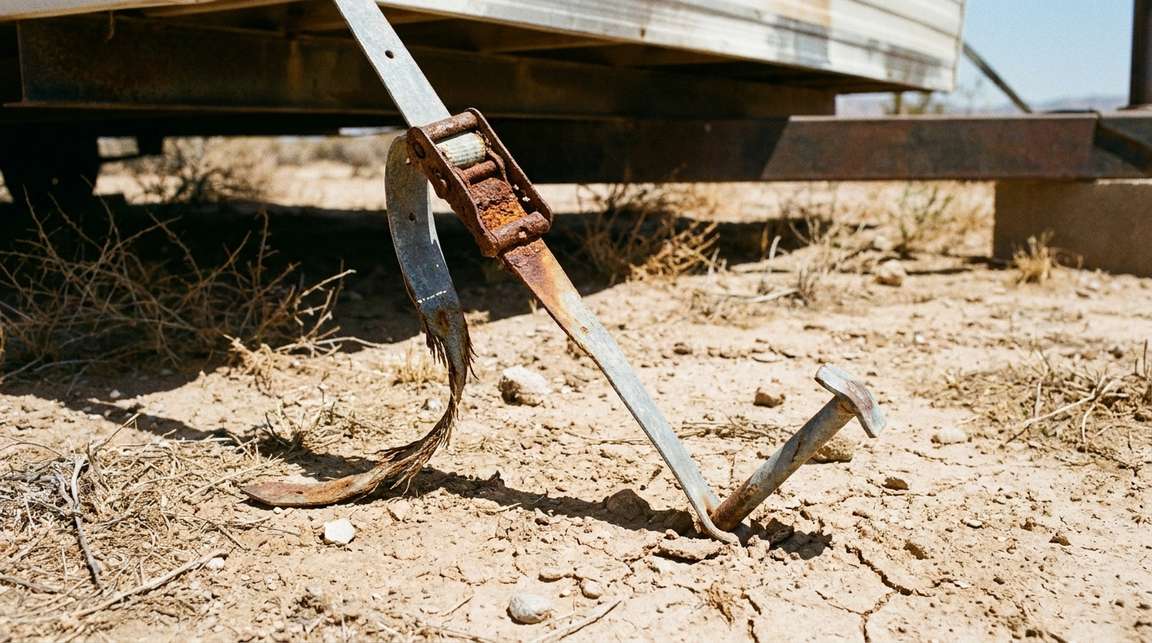
How anchors fail in this county
- The soil lets go. This is the Yuma-specific one. Anchors hold because the soil around the auger holds. Sandy valley soil is not the ideal medium for that, and when it gets wet — irrigation, a leak, a monsoon downpour on a low spot — it gets even less ideal. An anchor that is leaning or has cratered soil around its head is on its way out.
- Straps rust and stretch. Galvanized steel out in the weather for thirty years does what you would expect. Rusted, frayed, or visibly loose straps are not holding anything.
- Settling slacks it off. When your piers sink, the home drops and the straps go slack. A slack strap does nothing until the home has already started to move, which is far too late.
- There were never enough. Older homes were set to older standards. Some are under-anchored by any modern measure — and were from day one.
- Hardware fails. The buckles and connectors are the small parts that quietly corrode and let go.
What we do
- Inspect the whole system. Every anchor, every strap, every connection. Where they are, how many, what condition, how much tension.
- Re-tension what is sound. Often the majority of the fix — the hardware is fine and it has simply gone slack as the home settled.
- Replace what has failed. Rusted straps, failed hardware, anchors that have lost their grip.
- Retrofit where it is under-anchored. Add anchors and straps to bring an older home up to a standard that matches the wind it is actually going to see.
- Do it while we are under there. If we are already doing leveling, this is the cheapest anchor work you will ever buy, because the access and the setup are already paid for.
Insurance and park requirements
Two practical reasons this comes up beyond the weather. Insurers may want to know your home is properly anchored, and some ask for an inspection — particularly on older homes. Parks have their own rules, and a park manager can require compliance. If somebody has handed you a piece of paper about your tie-downs and you do not know what it means, bring it to us and we will read it with you.
In Arizona, the people who level, anchor, set and structurally repair manufactured homes are licensed by the Arizona Department of Housing, Office of Manufactured Housing — not by the contractor board that covers stick-built homes. Ask any company you call for their license, and ask whether the work needs an installation permit. A real outfit will answer both without flinching.Related repairs
Anchors travel with two other jobs: leveling (settling is what slacks your straps in the first place) and skirting, which keeps wind from getting under the home at all. All three are the same problem viewed from different angles — keeping your home where it is supposed to be.