Mobile Home Roof Repair & Coating in Yuma

Yuma has more sunshine than anywhere on earth, and your roof takes all of it. We repair leaks, recoat with elastomeric systems, and install metal roof-overs that end the cycle.

Call (928) 555-0143
Free estimates. Straight answers about what your home actually needs.
Mobile & Manufactured Homes Only
Yuma & the Foothills
Free On-Site Estimates
Park Model & Snowbird Friendly

Leak, stain, or a roof that has not been touched in years?

Get eyes on it before monsoon season decides for you. Free on-site look and a straight answer about repair versus coating versus a roof-over. Call (928) 555-0143.

  • Free on-site estimate, written before work starts
  • We work on mobile, manufactured and park model homes only
  • Seasonal schedules welcome — we work around snowbird arrivals

The short answer

A mobile home roof in Yuma has three realistic paths: repair the specific leak, recoat the whole roof with an elastomeric system, or install a full roof-over. Which one you need depends on how much life is left in what is up there. Coating buys 5 to 10 years and is the routine maintenance most homes here need on a cycle. A roof-over costs more and buys decades. We will get up there, look, and tell you honestly which one you are actually facing. Call us.

Why roofs are the number one failure on a Yuma mobile home

Because of the number at the top of this whole website: about 4,055 hours of sunshine a year, roughly 91% of all daylight hours — the most of any city on earth, per Guinness. Your roof is the surface taking all of it, all day, with nothing shading it.

Ultraviolet light degrades coatings and sealants. Heat cycling expands and contracts the metal — a roof surface here can go from searing to cold every single day, and each cycle works every seam and fastener a little looser. Then, for about three months a year, monsoon storms arrive with wind-driven rain that finds anything that has opened up. And on a great many of these homes there is a swamp cooler sitting on or beside the roof, quietly adding water to the equation.

That is why the local Facebook groups fill up every year with people asking who does mobile home roof repair in Yuma. It is the most needed repair in town and the hardest to get a straight answer about.
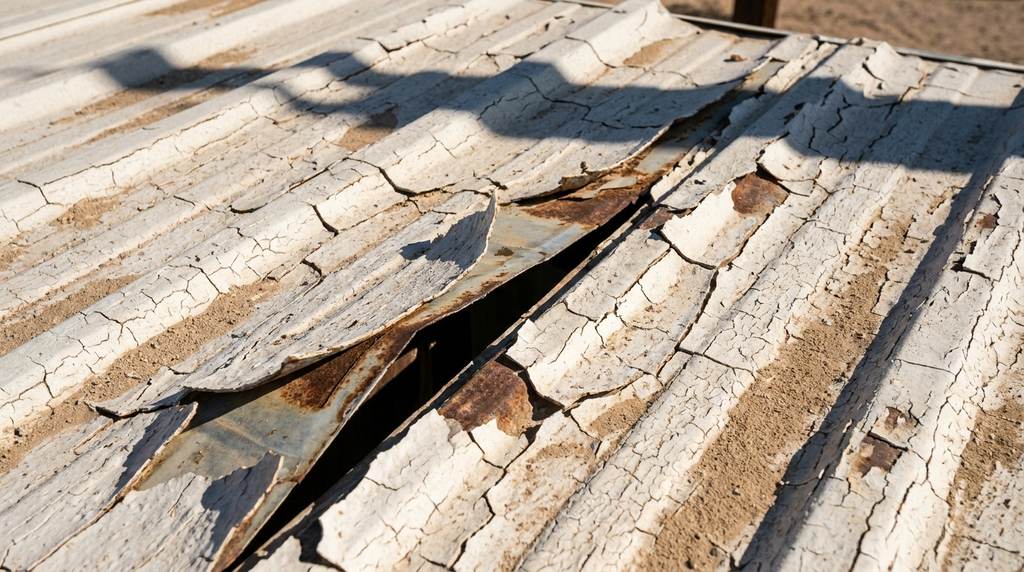
Failed white roof coating on a mobile home roof, chalked and cracked into an alligator pattern and peeling away to expose bare metal and an open seam.
A coating that has run out of life. Once the surface chalks and cracks like this, patching one spot buys you a month — the whole roof is at the end of its cycle and the seams are open.

Option one: leak repair

When the roof is fundamentally sound and one thing has failed. We find the actual entry point — which is very often not above the stain, because water runs along a joist or a duct before it drops — and repair it: reseal a seam, rebuild the flashing at a vent or the cooler penetration, replace a section of failed material, patch a puncture.

Honest limitation: repair only makes sense when the roof around the failure has life left. If the surface is chalked out and cracking everywhere, patching one spot means you will be calling about the next spot in a month. At that point you are buying coating, not repair, and we will say so.

Option two: elastomeric roof coating

This is the routine maintenance almost every mobile home in this county needs on a cycle, and the one most people skip until it leaks. An elastomeric coating is a thick, flexible, reflective membrane rolled over the whole roof. It does two jobs: it seals the surface, and because it is bright white, it throws the sun back instead of pulling it into your home. People notice the cooling bill.

How long it lasts: generally 5 to 10 years for acrylic before a recoat, 10+ for silicone systems. Applied properly it can add 8 to 12 years to a roof's life even in Arizona conditions. The spread depends on prep and thickness, which is the part nobody sees and everybody pays for later.

How it is done right: the roof gets cleaned properly first — coating over dust and chalk is money set on fire. Then the seams, the perimeter, and every penetration (vents, stacks, the cooler) get sealed and coated first, because that is where the leaks are. Then the field gets rolled in two directions, which puts extra thickness on the seams and perimeter and even coverage everywhere else. A cheap coating job is one where somebody rolls one thin coat over a dirty roof in an afternoon. It looks identical the day it is done.

Option three: a full roof-over

A roof-over installs an entirely new roof — typically standing-seam metal, sometimes a membrane like TPO — over the existing one, usually with a layer of insulation between. It is the biggest of the three numbers and the last roof conversation you will have for a long time.

It makes sense when: you are stuck in a recoat-and-chase-leaks cycle, the existing roof has no life left, you want the cooling savings from real insulation plus a reflective surface, or you are planning to keep the home a long while. It does not make sense on a home you are about to walk away from, and we will tell you if that is what we are looking at.
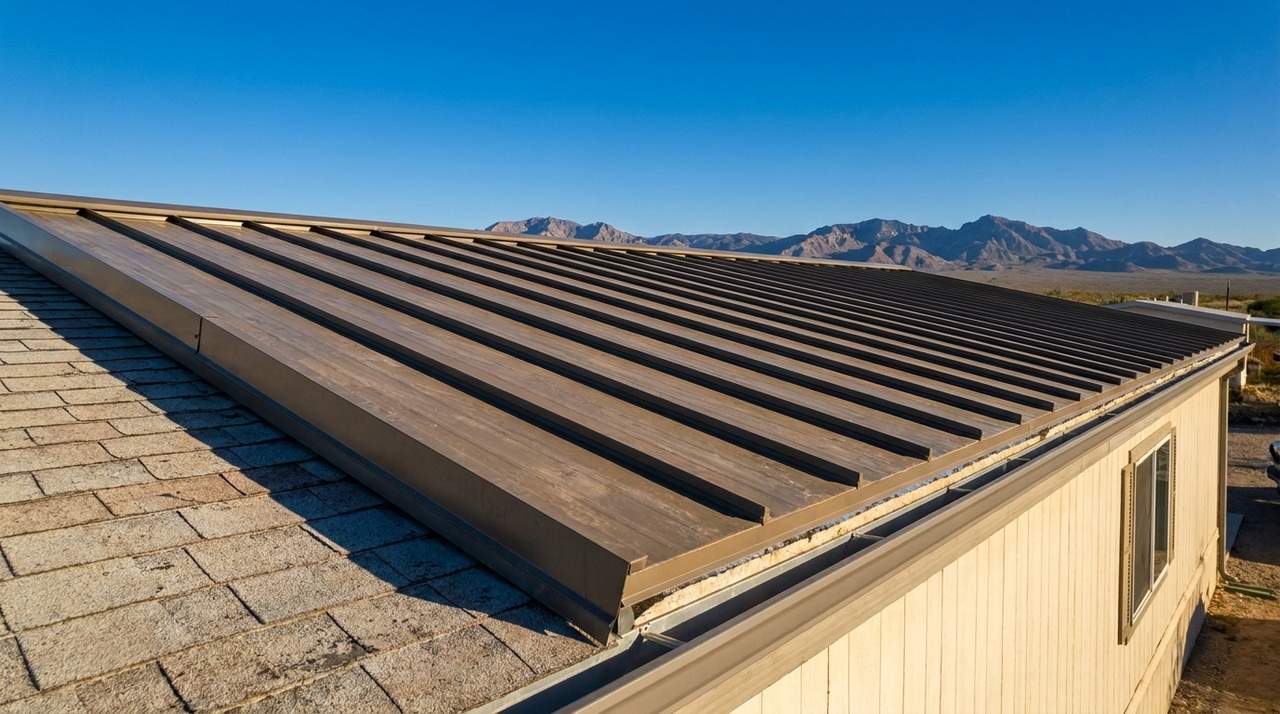
A standing-seam metal roof-over installed above an older manufactured home roof, with the original roof surface visible at the transition.
How a roof-over works: a new standing-seam metal roof goes on above the old one, usually with insulation between. You can see the original roof at the edge, still there, no longer doing the work.

Which one do you need?

Choosing between repair, coating and a roof-over
Your situationUsually the answerWhat it buys you
One leak, roof otherwise soundLeak repairFixes the problem without buying a roof
Surface chalking or thinning, no leaks yetCoating5–10 years, plus a cooler home
Coated a few years ago, leaking againInspect firstOften a prep failure or a bad penetration, not the whole roof
Recoating repeatedly, still chasing leaksRoof-overDecades, and the cycle ends
Roof is done — cracked, rusted, soft deckingRoof-overThe only real fix
Stain on the ceiling, unknown causeGet eyes on it nowFinding it early is the whole game

Last updated July 2026.

Before monsoon, not during

Monsoon season runs July through September, and every year it produces the same phone call: a roof that had a known, ignorable problem in May becomes an emergency during a 3am microburst. The cheapest roof work you will ever buy is the work you do in the spring on a problem that has not flooded your ceiling yet.

If you are a winter resident, this is doubly true. Your home sits through the entire monsoon with nobody in it. The roof is the thing to have looked at before you leave, not after you get back.

In Arizona, the people who level, anchor, set and structurally repair manufactured homes are licensed by the Arizona Department of Housing, Office of Manufactured Housing — not by the contractor board that covers stick-built homes. Ask any company you call for their license, and ask whether the work needs an installation permit. A real outfit will answer both without flinching.

Related repairs

A roof leak rarely stops at the roof. If yours has been going a while, the water went somewhere: check subfloor and soft spots (a slow roof or cooler leak is the most common cause of a rotted floor), and vapor barrier and belly if water made it all the way through. Interior ceiling and wall panel repair after a leak comes under remodeling.

Get your roof looked at before it leaks

The cheapest roof work is the work you do before a monsoon cell finds the seam. Free on-site estimate.

(928) 555-0143

Questions people in Yuma actually ask

How often should I recoat my mobile home roof in Arizona?

More often than the label says, because Yuma's sun is not the sun the label was written for. Acrylic elastomeric coatings generally give 5 to 10 years before they need recoating; silicone systems tend to run 10 or more. Applied properly, a coating can add 8 to 12 years of life to a roof even in Arizona conditions. The practical answer: look at it every year, and recoat when the surface starts chalking, cracking or thinning at the seams — not when it finally leaks.

How long does elastomeric roof coating last?

Five to ten years for a standard acrylic elastomeric, 10+ for premium silicone formulations, before a recoat is due. That range is wide because it depends almost entirely on prep and application thickness. A coating rolled thin over a dirty roof fails in two summers here. Coating is a system, not paint — the roof gets cleaned, the seams and penetrations get sealed first, and then the field gets its coats.

Can you put a metal roof over an old mobile home roof?

Yes, and in a lot of cases it is the right call. A roof-over lays a new metal or membrane roof over the existing one, usually with insulation between. It costs considerably more than coating, but it buys decades instead of years, it dramatically cuts your cooling load, and it ends the recoat cycle. The rough rule: if you are recoating every few years and still chasing leaks, or the existing roof is past saving, stop paying for coating and do the roof-over.

Why does my mobile home roof leak at the seams?

Because the seams are where two pieces of metal meet, and metal moves. In Yuma a roof surface can swing well over a hundred degrees between a July afternoon and a January night, and every one of those cycles works the seam and the sealant. That is also why seams, vents, and the swamp cooler penetration get sealed first and heaviest when we coat — the field of the roof is rarely where the water gets in.

There is a stain on my ceiling. How bad is it?

Unknown until someone looks, but do not wait on it. On a manufactured home the ceiling panel is the last thing to show a leak that has already been running through insulation and possibly into the walls or floor. A stain the size of a dinner plate can be a pinhole at a vent — or it can be the visible corner of a much larger wet area. It is cheap to find out and expensive to ignore.

Do you fix swamp cooler leaks on the roof?

We seal and repair the roof around the cooler and the penetration itself, which is where the water actually gets into your home — and it is one of the most common leak sources in Yuma. Servicing the cooler unit itself is an HVAC job; we will tell you if that is what you need.

Tap to Call — (928) 555-0143