The short answer
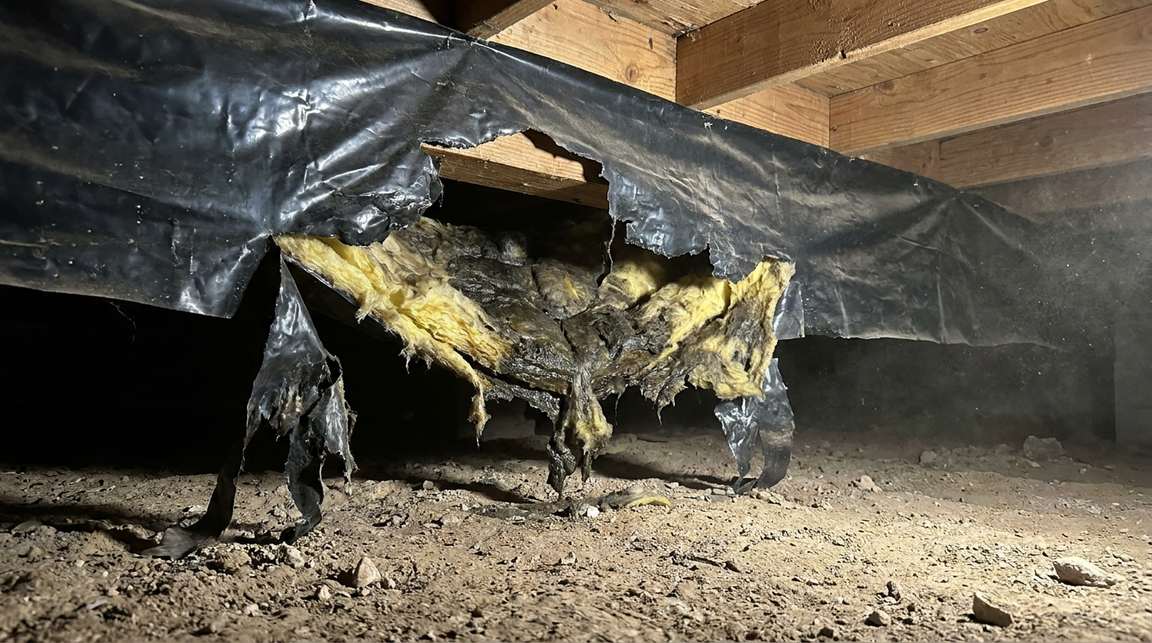
The black sheet under your home is the vapor barrier, or belly wrap. It holds your floor insulation up, keeps moisture and rodents out, and often contains your ductwork. When it tears — and in a forty-year-old home it has — your insulation sags out, your cooling bill climbs, and animals move in. We repair and reseal the underside. Call us for a free look.
What the belly actually does
Most people have never seen it and assume it is packaging left over from the factory. It is not. It is doing four jobs simultaneously:
- Holding your insulation. Floor insulation in a manufactured home is not nailed up — it rests on the belly wrap. No wrap, no insulation in contact with your floor.
- Blocking moisture. It keeps ground moisture from migrating up into the insulation and the underside of your subfloor.
- Keeping animals out. It is the actual barrier. Skirting is the fence; the belly is the wall.
- Containing your ducts. In many homes the HVAC ducts run inside the belly cavity, protected by that wrap.
It fails from age and UV, from rodents, from an old plumbing leak, from wind getting under the home when skirting is missing, and — very often — from a previous contractor who cut it open to do a repair and never sealed it back up.
Why this costs you money every month in Yuma
This is the repair that pays for itself, and here is the mechanism. Yuma summers run average highs around 107 degrees. Your air conditioner or cooler is fighting that for months. The floor is one of the six surfaces holding the cool air in, and it is only insulated because the belly wrap is holding that insulation against it.
Torn belly, sagging insulation: you are now cooling a home with a substantially uninsulated floor. Torn belly plus separated ducts: you are actively pumping cold air into the dirt under your home and paying for every cubic foot of it. People notice this one on the bill, and they notice the fix too.
What we do down there
- Look at all of it. Where the wrap is open, where insulation is missing or soaked, whether ducts are intact, whether anything is living down there, and whether there is a moisture source we should be chasing.
- Find the water first. If insulation is wet, something is wetting it. Sealing a belly over an active leak just hides it, and it is your floor that pays.
- Clear out what has failed. Soaked or nested-in insulation is not insulation. It comes out.
- Replace the insulation. New batts, in contact with the floor, where they belong.
- Seal the ducts. While we are in there. Reconnect what has separated, seal what is leaking, replace what has been chewed.
- Close the belly properly. Repair tape on sound wrap; new material where it is too far gone. Sealed, supported and closed — not draped.
- Close the doors behind us. If the rodents got in through a missing skirting panel, sealing the belly alone just means they chew a new hole. The two jobs go together.
Evaporative coolers and the moisture nobody thinks about
Yuma runs on swamp coolers, and swamp coolers add water to a home by design. That is fine when it goes where it should. When the supply line to a rooftop cooler weeps, or the pan overflows, the water goes down — through the roof structure, sometimes down inside a wall, and eventually into the floor and the belly. If you run a cooler and you have a soft floor or a soaked belly, look there first. It is one of the most distinctly local causes of underfloor damage we see.
In Arizona, the people who level, anchor, set and structurally repair manufactured homes are licensed by the Arizona Department of Housing, Office of Manufactured Housing — not by the contractor board that covers stick-built homes. Ask any company you call for their license, and ask whether the work needs an installation permit. A real outfit will answer both without flinching.