The short answer
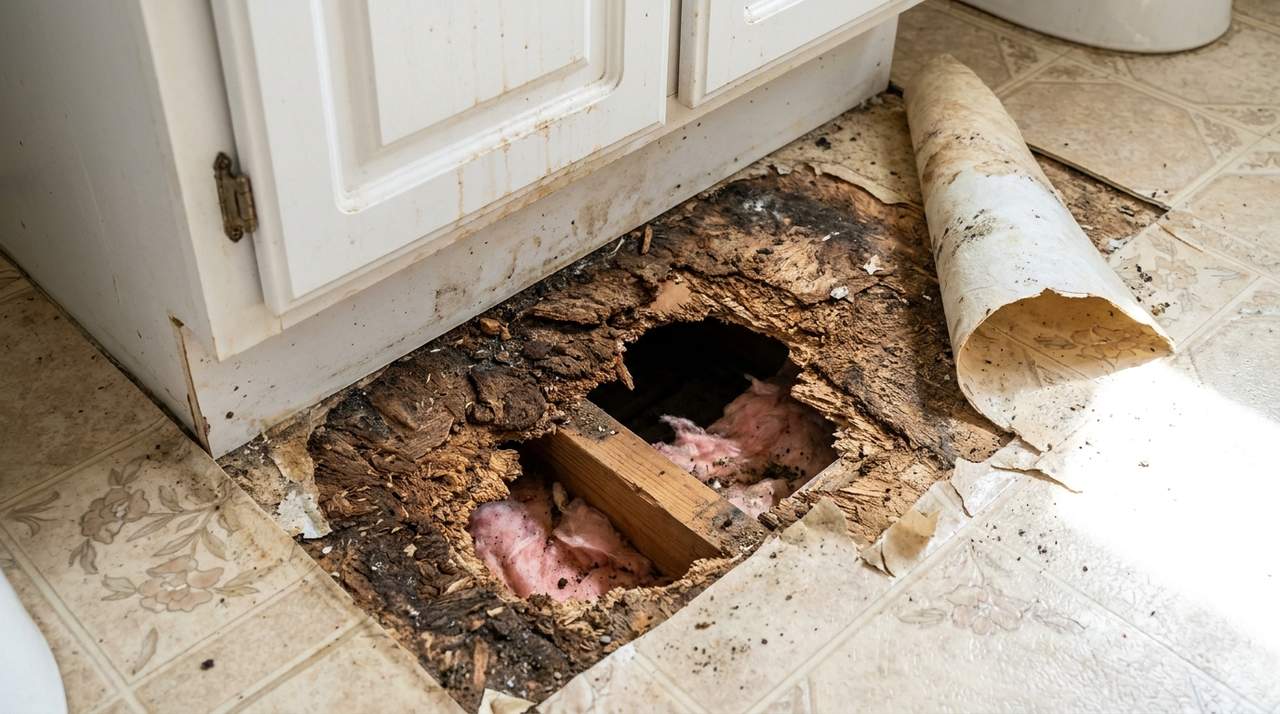
That spongy patch by the tub is rotted particleboard subfloor, and it is the second most common failure in a Yuma manufactured home after the roof. The fix is to cut out the failed board, repair or sister any rotted joists under it, seal the belly wrap back up, and lay in new decking. Local figures for sub-floor repair run roughly $800 to $3,000 and up depending on how far it has spread. It does not get better on its own. Call us and we will find the edges of it.
Why mobile home floors fail
Your floor is likely particleboard — wood chips and glue pressed into sheets. Dry, it is fine and it has held your home up for decades. Wet, it does not rot slowly like plywood; it swells, loses its bond, and turns into something with roughly the structural value of a wet cracker. And it does not recover when it dries out.
So the question is always where the water came from. In Yuma, in order of how often we find it:
- A slow plumbing leak. A supply line weeping behind a wall or under a tub for months. This is why soft spots cluster at the bathroom, the kitchen sink and the water heater.
- The swamp cooler. The line running to it, the pan, or the roof penetration around it. Coolers are wonderful and they leak, and this is a distinctly Yuma cause.
- A roof leak that traveled. Water gets in at a seam, runs along a joist or a duct, and comes down somewhere else entirely. This is why the stain on your ceiling and the soft spot in your floor are often in different rooms and the same problem. See roof repair.
- Toilet and tub seals. A failed wax ring puts a small amount of water in the same place for years.
- Condensation and a torn belly. If your vapor barrier is open, moisture gets at the floor from below.
- An empty house. Every one of these is worse when nobody is home for five months to notice.
How the repair actually works
- Find the edges. The soft spot you feel is the middle, not the boundary. We probe and open until we reach board that is sound, which is often further than anyone wants it to be.
- Find the source. Non-negotiable. Replace the board without stopping the water and you have bought yourself the same repair in two years.
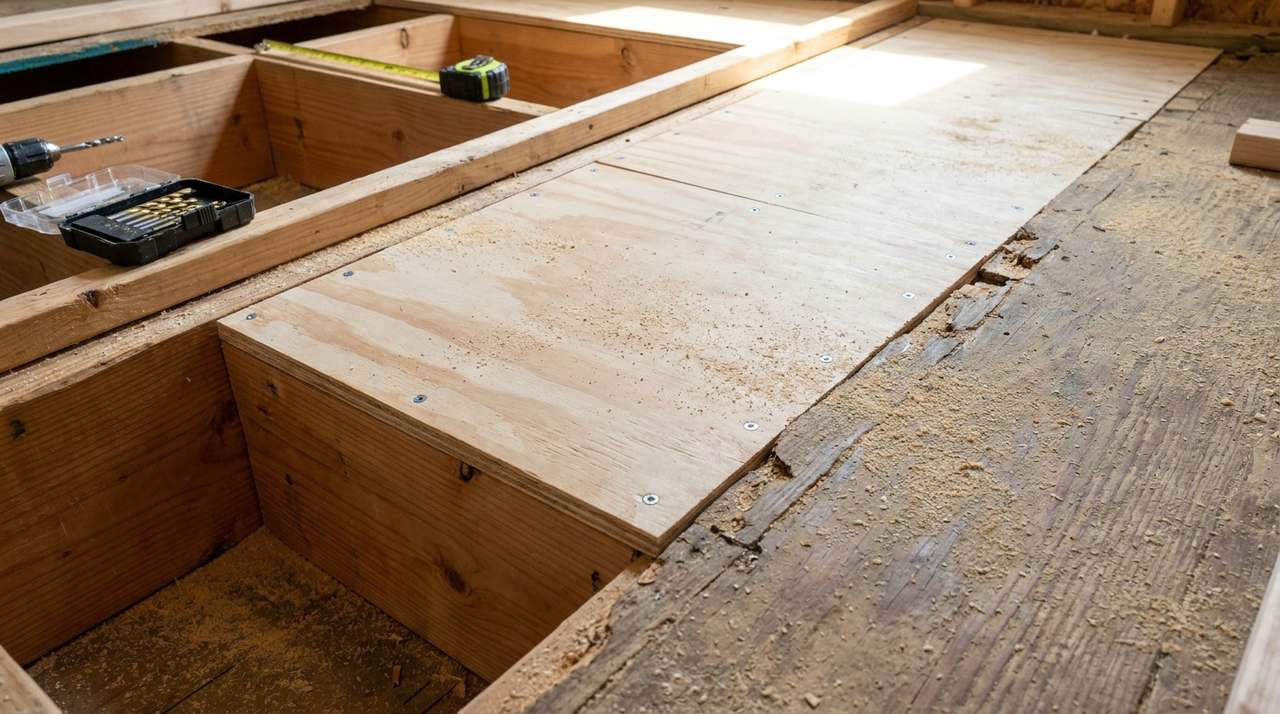
- Cut it out to the joists. The failed decking comes out cleanly, cut back to bearing so the new material lands on something.
- Deal with what is under it. Often the joists are fine and only the decking failed. Sometimes joists are rotted and need sistering or replacing. Sometimes the insulation below is soaked and has to come out. You cannot know until it is open.
- Seal the belly back up. This is the step that gets skipped by people who do not do manufactured homes. That black wrap under your floor is a system — it keeps moisture, rodents and desert air out of your insulation. Cut into it and leave it open and you have traded a floor problem for a different, slower problem.
- New decking in. Plywood, typically, because it handles a future wetting far better than the particleboard that just failed you.
- Flooring back on top. Whatever you want to walk on.
Why you cannot just cover it
This comes up on every one of these jobs, so here it is plainly: laying new vinyl plank over a soft spot does not fix anything. The new floor is not structural — it is riding on the rotted board underneath. Within a year the seams open where it flexes, and now you have paid for flooring and still have the original problem, except now it is hidden under something you paid for.
If somebody quotes you a floor-over on a soft spot, that is a company betting you will not call them back. The board has to come out.
What it costs
Google's local data for Yuma puts mobile home sub-floor repair and re-leveling work in the $800 to $3,000+ range, with basic service calls starting around $150. That matches our experience. What moves the number:
- Square footage. A three-foot patch beside a toilet versus a whole bathroom versus a hallway and two rooms.
- Are the joists gone too? The single biggest swing. Decking is cheap; structure is not.
- Belly wrap and insulation. If the wet went all the way through, that gets opened, dried, replaced and resealed.
- The source. Fixing a wax ring is trivial. A failed roof penetration feeding the leak is a second job.
- Flooring. Whatever you want on top.
Last updated July 2026. This is the repair that most often turns out bigger than it looked from the surface, which is exactly why we quote from an opened floor rather than a phone call.
In Arizona, the people who level, anchor, set and structurally repair manufactured homes are licensed by the Arizona Department of Housing, Office of Manufactured Housing — not by the contractor board that covers stick-built homes. Ask any company you call for their license, and ask whether the work needs an installation permit. A real outfit will answer both without flinching.